[00:00:03] Interviewer (Tracy):
Welcome to Care Is Everywhere. A Carers Queensland podcast.
Are you looking for a new career in community services but are struggling to find the time and money? Here at Carers Queensland, we understand the demands on carers and have responded by designing certificate courses that work with your caring schedule. Whether you want to upskill or change careers, our quality course content and experienced trainers will guide you through a carer qualification or short course. The future of training is evolving and so are we. We now offer more flexibility, better content and dedicated student support with a caring touch.
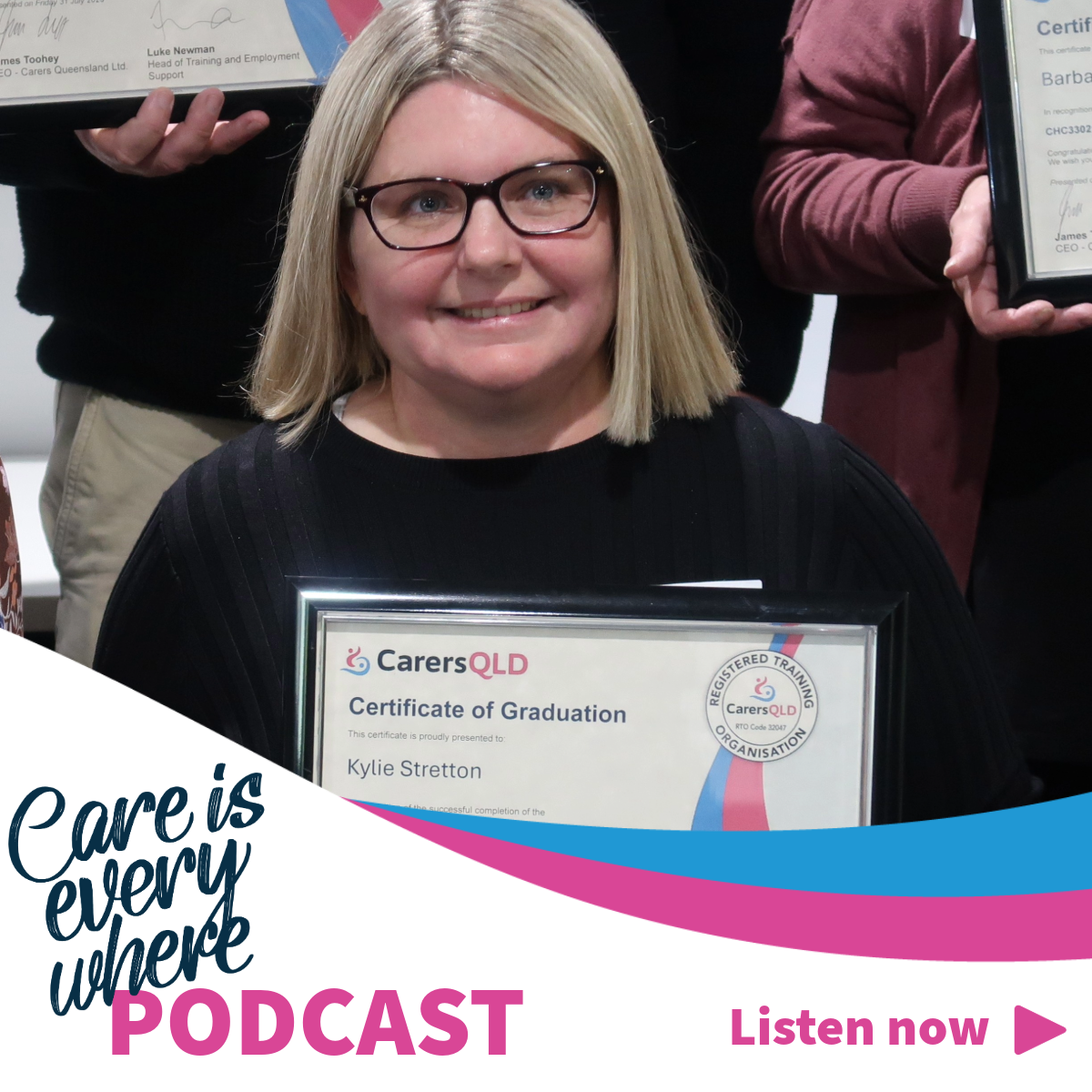
In this episode we speak to Kylie from Brisbane, a full-time carer of her two boys and a graduate of the Certificate III in Individual Support (disability). With the support of Carers Queensland and the NDIS, Kylie is now working full time in community services and has big plans for her future. I started by asking Kylie about her caring role.
[00:01:10] Kylie: When I was born my auntie was 13 and when she was three years old she caught the measles, they went to her brain and caused brain damage and then her brain stayed as 3 year old for the rest of her life.
So I was very close to my nana and my auntie and I spent every like holiday, school holidays and a lot of weekends over there helping my nana take care of my auntie. And then when I was 27 or when I was 26, I was, I gave birth to my second-born son, who was born with phenylketonuria, so PKU for short, which is a rare metabolic disorder where his body cannot break down protein.
So it was a very strict diet and you have to, you have to measure, record every bake and cook everything that goes into his mouth. So that was a very full time job on its own.
And then 13 months later his brother was born, my third born eight weeks premature where he wasn't breathing for 15 minutes. So lack of oxygen to the brain caused cerebral palsy, spastic quadriplegia, and then later on he got diagnosis of epilepsy, vocal seizures, severe intellectual impairment, cortical visual impairment and cerebral atrophy. And my other son with PKU also got diagnoses of dyslexia, social communication disorder, chronic anxiety and a few others. So my husband and I stayed home for 16 years to raise our children and take care of our two children with high needs full time.
[00:03:10] Interviewer (Tracy): It's been a long journey. Kylie. How has Carers Queensland and the NDIS helped you in your caring role starting out with Carers Queensland?
[00:03:18] Kylie: So, so my sons were born up at Cairns Base Hospital and then when, when our sons were 15 months and 2 months old. We moved to Rockhampton for their father's work.
And then we were in Rockhampton for 18 months. In that time we were in Rockhampton, we found out that our son that has cerebral palsy. There was going to be like five different surgeries and both of our kids were going to have a specialized team at the, it used to be called the Brisbane Royal Children's Hospital.
So we found out that we would have to be down in Brisbane every couple of weeks for appointments and to see their teams and surgeries. So we made the decision to move to Brisbane.
When we moved to Brisbane, I was four months pregnant and with their little sister.
And I gave myself like five months. I gave myself from when we moved to Brisbane to when I gave birth to her. Okay. Not realizing how much it takes to set up a child with special needs with disabilities and create a support group and all that. But I was like, gave myself five months. Okay. Going to sort out this family within five months. Gonna have everything set up. Okay, I'm gonna ring, I'm gonna ring around, I'm gonna get on the Internet, do my research and find whatever I can find, whatever services I can find, resources, supports, groups, anything I could find. I was going to do that in five months in Brisbane. And one of the first things I came across was a Carers Queensland support group in Caboolture at the RSL Care.
So we started attending the Carers Queensland support group every Tuesday morning for a morning tea. And then that turned into a retreat and also it turned into counselling and financial support and yeah, a few other services. And then when our son was, I think.
Oh yeah, when our son was 10, NDIS came out rolled out in Caboolture and, and it helped us a lot to be able to start having support where we could do things for ourselves and do different things that everyone else takes as luxuries.
Because it was just before NDIS it was just 10 years of non-stop caring, not getting a break. So when the NDIs came in, we could.
His support slowly built up. Where to start with, it was just two hours to go and have a date night and then now it's turned into that both of his parents can go and work full time.
[00:06:45] Interviewer (Tracy): It's just wonderful, isn't it? And I suppose those supports in freeing up your time to live your life, did that influence your decision to study the Certificate III in Individual Support with Carers Queensland?
[00:06:59] Kylie: Definitely.
So when my husband and I were given the opportunity to open a support provider branch in Queensland where head Office is in Coffs Harbour in New South Wales.
We knew we had to play catch up. Like we were given this opportunity because of our personal experience, because of our 16 years of personal experience and what comes from taking care of a child in a wheelchair. Like there was a lot of experience from there but personal experience wasn't, still was not going to be enough to build and run a support provider branch in Queensland. So we had to play catch up with the professional side of things.
And as soon as we knew we had to do this we were like all we could think of was Carers Queensland. We didn't know of anywhere else.
[00:07:57] Interviewer (Tracy): So tell us about the course. You studied the course, what did you learn?
[00:08:01] Kylie: I learned a lot. I didn't honestly ego side of me. Like I've been doing this for 16 years, I know how to, I know how to hoist, I know how to do transfers, I, I know how to do slide sheet, I know how to do all the practical stuff but there was still a lot of stuff that I didn't know.
Being able to do the Cert 3 and learning all about incident reports and all of the backend workplace health and safety, duty of care, dignity of risk, choice and control independence.
Yeah, there was a lot of the back end stuff that I didn't know about like the NDIS practices and standards, the laws, the compliance stuff. So it helped a lot with my new role.
[00:08:59] Interviewer (Tracy): What were you particularly appreciative of in the way Carers Queensland delivered the course to you given your role as a carer and the demands of your personal life?
[00:09:08] Kylie: The thing that there was a few things but the thing that stood out the most for me is I had someone from Carers Queensland Register of Training department reach out to me every couple of weeks to check in with me and life got crazy where my son had to go. Like life got crazy with seizures, surgeries, medication changes, hospital missions, appointments and then also trying to help my husband, support my husband in building the branch and getting that all set up.
So to have those check ins every couple of weeks to see how I was traveling with my training and to be able to talk about what's going on in my personal life.
So, so when I did, when I did come across really big challenges and busy, more busy moments in my life than normal, I then quick, the representative from Carers Queensland would sit down with me and work out a plan with me and how they could help and support to make sure I still finished my certificate.
[00:10:30] Interviewer (Tracy): Do you find that that was so important to you being a carer?
[00:10:37] Kylie: Definitely, when you have rougher nights than normal with the, with the loved one that you're taking care of. Especially when it comes to like taking care of someone in a wheelchair or like with cerebral palsy. There's so much that's involved during the night and some nights can be with our sun, some nights can be better and then other nights can be rougher or depends on what's going on. But you can wake up to seizures, sickness, being wet, like the whole bed, being drenched by midnight, needing a drink, hungry, in pain.
So when you're having like not like back to back nights of this, but then you have to get online and attend class and you have like 10 assessments that are due.
It is, I think the support calls are extremely important.
[00:11:37] Interviewer (Tracy): You know, given all of that, you went through the course, you graduated from the course, how did it feel when you actually got through and got to the end?
[00:11:46] Kylie: What's next? I was really, really happy that I finally got my certificate and I do want to go on to Diploma of Management but it's just very difficult with building and running a support provider branch as well as setting everything up for our son and our sons and taking care of them.
So yeah, I was excited I got my certificate but I was focused on now I can go and get my diploma.
[00:12:19] Interviewer (Tracy): Well, let's talk about what you've done since you graduated because the course gave you a lot of knowledge and skills that you're now using. Can you tell us about your new job in community services?
[00:12:30] Kylie: So my new position is a full-time administration officer at SCL Support Support Services Queensland. So I have used in that position. I've used everything that I learned my Cert 3 to like, yes, it's Cert 3 is not an admin course. But there was still a lot that I, a lot I learned with the like with the incident reports. Like Cert 3 goes through incident reports, you have to fill out heaps of.
For 10 incident reports and you know, progress notes and all of the paperwork. So yeah, Cert 3 really helped me with this position of admin and the compliance side of NDIS.
[00:13:21] Interviewer (Tracy): Because you've chosen to use your course to work in this sector and how does it feel to actually be working full time?
[00:13:30] Kylie: I have never ever had a full time job in my life and I received my first pay slip two weeks ago and I walked into Centrelink after being on Centrelink for 45 years due to like my childhood. And then I went from my childhood to being a single mum and Then being a single mum to being a disability carer, I, it felt, it was a really strange moment in that Centrelink office when I was reporting that I am now full time, like full time employee and no longer need Centrelink. It was like I just, it felt freeing, life changing and like my future looks, my future can look way more different than I ever thought it would. Like, I just thought I would have to take care of my son 247 around the clock for the rest of my life.
And there's nothing wrong with that, but having balance gives you a happier life, being able to balance it all out.
[00:14:55] Interviewer (Tracy): And it sounds like with the supports of the NDIS, the supports of Carers Queensland and now your working job, you've been able to find that balance correct. Somewhat.
[00:15:07] Kylie: It's a work in progress because my son graduates school at the like, graduates year 12 at the end of the year and we are, and he just turned 18 last week. So we are transitioning from like paediatric into the adult world.
So yeah, it's going to take a lot of work out of hours, but yes, but I am getting there. I feel like having a full time job and having something else to focus on.
I feel like, I feel like it's, my life's a lot more balanced than just focusing on one thing.
And also like my son was a 24, my son was a 247 crying baby.
So when he was born he just cried 24 hours a day.
And like he got back when he was 10 months old, he got put on Baclofen as a muscle relaxer for a cerebral palsy. But that crying just kept going and then as he got older the crying turned into screaming for we could have like a six-hour episode of screaming. So my main focus was on that and getting help for that and trying to get like secondary diagnoses which we did get secondary diagnosis by the time he was 14, but once my focus was redirected there's not as much of that behaviour anymore.
[00:16:38] Interviewer (Tracy): So Kylie, if you think about life this week and that balance between that full time role, you're still in a caring role for your sons. Yes, but how has that role changed now that they're older and you're working?
[00:16:53] Kylie: Since all of my kids, my youngest is 16, so since all of my kids are almost all adults, it's given me more time to be able to be of service in other places and to be able to follow my purpose and my passion and to be able to help others and use the, my personal experience.
[00:17:21] Interviewer (Tracy): What is your purpose and Passion.
[00:17:23] Kylie: My purpose and passion is to, to provide care for, for everyone that needs it and deserves it and just to provide like good, quality care and that they're not just a number. Like, the biggest thing for me is clear and effective communication.
You're not just a number. Like, you're, you're a person with certain needs that need to be matched up with a certain support worker. It's not just a gap. You're not just a gap. Fill in the roster. And the roster is my. I'm a Virgo, so I love organizing and planning and I just, When I get a roster check, when I have to, when I, when I receive a roster change that has to be made, it's like Christmas for me. Like, I just absolutely love. My brain loves working with the rosters and organizing it all. But it's not just a puzzle where you're trying to fit in the gap and put all the pieces together. It's like these are real life people with real needs that need real life, you know, support staff that can meet those needs and support them with their specific interests and needs that they get.
[00:18:53] Interviewer (Tracy): Well, you're obviously very passionate about it and I can see, and a lifetime really of being in that caring role. What would you say to someone who is listening to this thinking, oh, maybe I will do that course, maybe I could take that Cert 3 on. But they're a little bit unsure about whether they can balance life. What would you say to those people?
[00:19:14] Kylie: Reach out and ask for help and set up support and yeah, go for it. Because I do believe I have met some rare, incredible human beings in this sector that do not have personal experience. But I still believe that personal experience does make a difference in this sector.
[00:19:43] Interviewer (Tracy): And you bring a wealth of personal experience to this, don't you?
[00:19:47] Kylie: Thank you.
[00:19:47] Interviewer (Tracy): Yes, yes. Thank you for talking to me today.
[00:19:49] Kylie: Thank you so much.
[00:19:51] Interviewer (Tracy): And that was Kylie from Brisbane, Carer and graduate of our Certificate III in Individual Support Disability.
[00:20:04] ANNOUNCEMENT:
Here at Carers Queensland, our registered training organisation has delivered subsidised and accredited training for more than 15 years. With our aged care and disability training, you can learn the skills to support the community and improve lives.
Whether you want to upskill or change careers, our quality content and experienced trainers will guide you through a carer qualification or short course. The future of training is evolving and so are we. We now offer more flexibility, better content and dedicated student support with a caring touch. Want more information about our training?
Connecting with us is easy. Visit our website @carersqld.com.au or call us on 1300, 747, 636 or email
[email protected]
[00:21:01] Interviewer (Tracy): Our final interview today is with Brendan from our Training Employment and Support Unit, who explains how Carers Queensland can work with you to achieve your learning goals.
[00:21:12] Brendan: Carers Queensland approaches industry and organisations. They advise us of the skill sets they require and we meet the needs of the clients. We go through a process of exchange, highlight and develop that we tailor to their requirements. Empathy and understanding is always at the heart of our approach. Each client is an individual and all our courses we develop skill sets so the students can work with the individuals to improve their quality of life when receiving care.
[00:21:41] Interviewer (Tracy): Can you tell us about what you did before you worked here at Carers Queensland?
[00:21:46] Brendan: Sure. Where do I start? I worked in radio as the Black Thunder Coordinator for B105 and that was a really enjoyable role. We're the highest rated nation radio station in the nation for eight years in a row. So that was a real exciting place to be and, you know, and to be a part of, actually after that. I worked for the Commonwealth Bank for 10 years, did a decade there as a business analyst in project management. Really enjoyed that. And that's when I started doing the customer service sort of stuff that I, I picked up on and I loved it. I loved it. After the Commonwealth Bank, I then started working in RTOs and I really enjoyed that space and I wanted to continue a career in that and I ended up working for Carers Queensland and I'm loving it here.
[00:22:37] Interviewer (Tracy): What do you enjoy about helping students?
[00:22:40] Brendan: Oh, look, it's great to see them, you know, come in and they might have fears about studying, they might not study for a long while and. Yeah, and watching that fear change, you know, and watching them go on their journey, their studying journey and the end result, you know, them getting a job and then being confident within their own self.
[00:23:00] Interviewer (Tracy): Yeah, some people who come to Carers Queensland are carers themselves and really have to juggle their personal life and the course. How have you supported those people?
[00:23:12] Brendan: We literally on the same journey with them from start to finish. Some of the people, some of the students that come through, you know, they got fears they, they're experiencing, they might have done study for a long while and so things have changed. You know, they've gone through a classroom environment and now they're online. So that's a bit of a scare factor for them. Yeah. And we nurture them through that. We're here to help and make sure that their journey is wonderful and enjoyable. You know they are our front line when it comes to caring for people and it's important that we look after these people as well.
[00:23:49] Interviewer (Tracy): Yes, it's so important to offer those tailored person-centred supports, isn't it? Why study with Carers Queensland though, Brendan, and not another provider?
[00:23:59] Brendan: Well, you're not just studying with a training provider, you know, you're learning with a respected community organisation that has been supporting carers, families and communities across Queensland for more than three decades. As Queensland's peak body for unpaid carers, Carers Queensland bring real world industry insights, strong community connections and genuine commitment to improving lives.
[00:24:22] Interviewer (Tracy): Yeah, we spoke to Kylie earlier in this episode and she really spoke to how Carers Queensland was able to do that and she studied a Certificate III in Individual Support (disability). When students study one of these courses, either ageing or disability in individual support, what can they expect to learn?
[00:24:42] Brendan: They will develop the knowledge, skills and practical experiences required to provide person centred support to older people and people living with a disability. The qualification prepares learners to work effectively within the community services and care sectors while promoting independence, wellbeing and dignity and inclusion.
[00:25:00] Interviewer (Tracy): I suppose the community service sector has a high demand for qualified workers. What growth have you seen in the industry in recent years?
[00:25:09] Brendan: Well, aged care and community sector have undergone a huge overhaul and job opportunities have exploded.
In 2025 there was 85,200 people living with dementia in the community and I believe that's going well. It's predicted to rise by 98% by 2054, which is big and that's due to the baby boomers. So there's going to be jobs for quite some time for support work, definitely.
[00:25:36] Interviewer (Tracy): So if you think about pathways then there'd be a very strong pathway to employment for our graduates.
[00:25:42] Brendan: Oh, absolutely. Through the qualifications, students can gain industry qualifications and learn the practical skills and workplace experience and gain the confidence in getting work.
[00:25:57] Interviewer (Tracy): Well. It's a wonderful service we provide. Thank you for joining me today.
[00:26:01] Brendan: Thank you, Tracey.
[00:26:03] Interviewer (Tracy): And that was Brendan, one of our student support officers. Always ready to support our students.
If you'd like to find out more about the wide range of courses we offer, visit our website, carersqld.com,au/training or phone 1300 747 636. Thanks for listening.