Episode Transcript
Welcome to Care Is Everywhere, a Carers Queensland podcast. This NAIDOC week, we celebrate 50 years of deadly, honouring the strength, resilience and achievements of First Nations people.
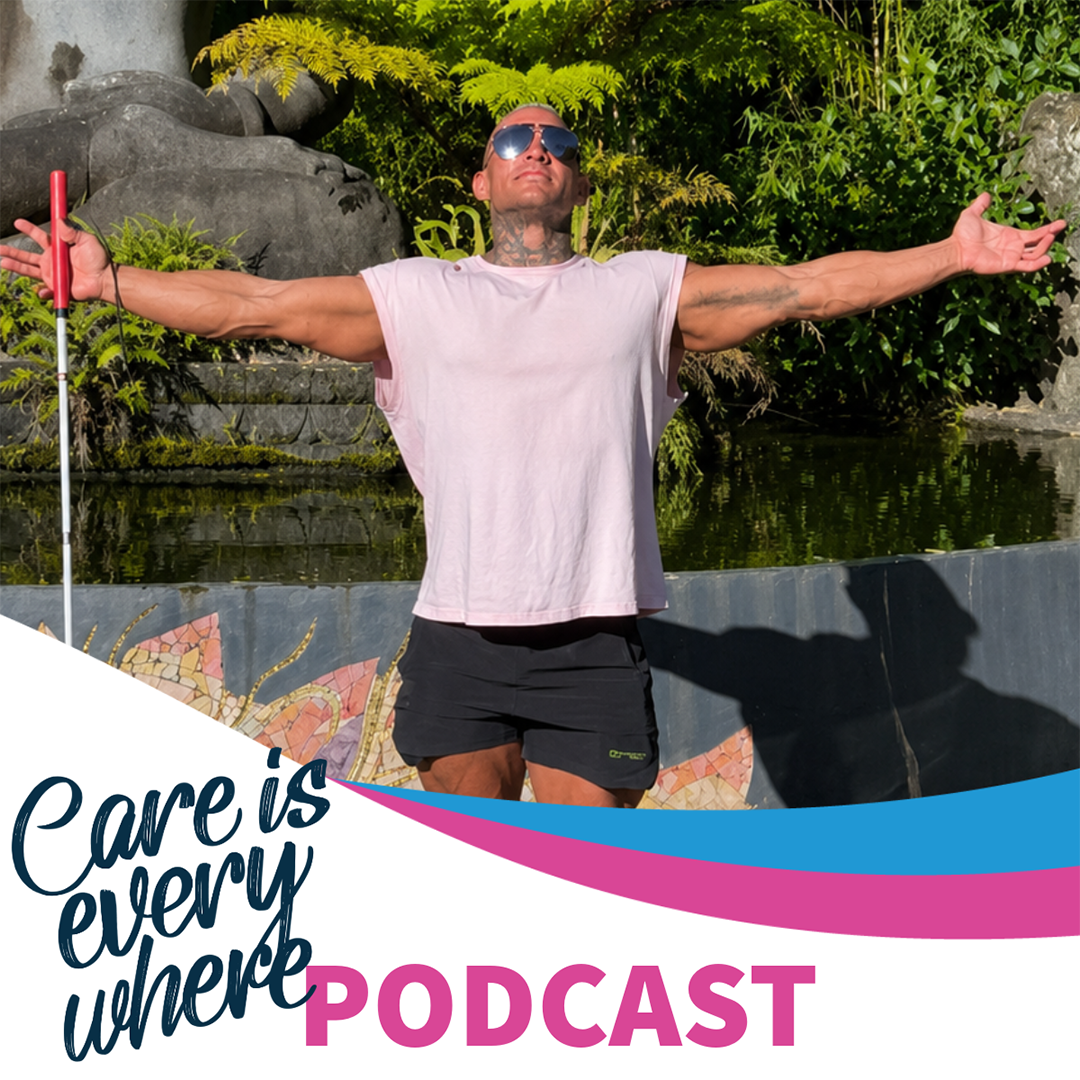
Today's guest, Dessy, is a proud First Nations man from the Gold coast whose story reflects that spirit. After an accident left him legally blind, Dessy has overcome challenges to now provide inspiration and support to First Nations young people studying First Nations youth work and driven to give back. Dessy is passionate about helping others find purpose and a content warning. This episode discusses suicide and mental health. Listener discretion is advised.
I started by asking Dessy about ‘NAIDOC Week 50 Years of Deadly’ and what that means to him.
[00:00:55] Dessy: Well, Deadly means a lot to me now because now that I've been learning more about Aboriginal and the way it is and how they want to help people and how they want to try to change the world and bring everyone together, I'm absolutely loving it and it means a lot to me to actually be an Indigenous person. I'm from Tasmania, the tribe was called Palawa Kani, but I actually didn't know. Well, I got told by my mother that I was Aboriginal, but I never actually truly found out until I started talking to my grandma. I can try, strive to be a better person and my main goal is to help everybody out and try to become better and better within the community and I think the community should be getting stronger and stronger together.
[00:01:41] Interviewer (Tracy): Can you take us back to the early days of your life? You said that you weren't, you didn't know that you were a First Nations man. Can you tell us about that?
[00:01:51] Dessy: Oh, it's hilarious. So I grew up in a town called Mount Isa and when I was a kid I went to school with lots of Aboriginals as well and I got along with them, they were my mates. And my first football team was called the Wanderers as well. And like I'm half cast color so I'm like tanned. But these kids were dark, were a lot darker than me and they used to be our white boy can't run and stuff like that. And yeah, and yeah, it was and then now I actually find it hilarious because I was Aboriginal the whole time.
[00:02:24] Interviewer (Tracy): So how did you find out about your culture and your heritage, Dessy?
[00:02:29] Dessy: Well, my mum told me it was Aboriginal, but I only found out five years ago properly. And I got my whole family tree down to the 1400s from my actual grandma. I've never met her in my life because my mum was adopted to a white family and yeah, it was a big thing for me and she sent through all of her family tree with 1400. And then also on my mother's side, her dad was also Aboriginal as well, so I got all of his side as well, all the way back to the 1400s. It's insane how much I've got now. Well, it's bit emotional for me because I'm still trying to get connected and I'm trying to learn more things about it and like, about, like, the reason why, like elders, like, there's this one elder that I knew on Mount Isa, Richard Percy, and he's got three scars across his chest and he was the leader and like, stuff like that. And I'm learning more and more. I'm going to go make a didgeridoo soon with my support coordinator because he's Aboriginal as well. His name's Dion, and he's getting me more in touch with the community. And then my friend Robbie, Robbie Marjoribanks, he's been involved with me in the Aboriginal community as well. And I also go to the Men's Mental Health Diaries with the Aboriginal community, with Wade as well, through Cowan. But that's how I'm getting in touch with the Aboriginal community through Cowan. It's been really good.
[00:03:56] Interviewer (Tracy): How has that made you feel to reconnect with culture?
[00:04:01] Dessy: Well, it's made me feel very emotional, but it's also made me see how good it can be to help others out and feel about yourself, about your culture.
[00:04:17] Interviewer (Tracy): Now, I know you're very big on personal motivation. Dessy, can you tell us about your life at the moment and what you try to do to improve the lives of others?
[00:04:31] Dessy: Well, my life at the moment is…. It's hard. But the thing is, I wake up and I can barely see anything. I've only got 13% vision. And the thing is, I try to do everything myself, but I can't. So I have my support worker to help me. But I'm that driven and I do not give up on myself. And I always think positive, one foot in front of the other. And I don't want to stop until I achieve everything I can achieve. And I won't stop.
[00:05:00] Interviewer (Tracy): What do you want to achieve, Dessy?
[00:05:04] Dessy: My main goal to achieve is I want to create for our youth and our youth crime justice system. I've been working with a lady, she works on a place called Fighting for Youth and she's established a place called Fighting for Youth. And what they do there is they teach kids how to have more compassion. That's one of the best things I like because we need more of that in our lives is. So one day we went and helped out a homeless shelter centre, and it's where they live and they needed a fence painted, so we painted a fence for them. And this kid was like, oh, I'm not doing this. And I was like, hey, come on, you got to help me. Like, I can barely, barely see. I couldn't see what I was doing, but, yeah, anyway. And he's like, oh, what are we even doing this for? I was like, mate, have a think about what you're doing. These people don't have a home. You do. And then he came. Good. And then the next day would mow someone's lawn that needed help. And. And then we do classes like this one that's called ACDC. So actions can. Actions, consequences, discipline and choices. What happens when you have a bad action? You get a bad consequence and you get a bad decision and you make a bad choice.
And then what happens when you have a good action? You get a good consequence, good discipline, good choices. So I was trying to teach them in their life to start making good choices and then we'll go through scenarios of what they did or who they hang around and stuff like that. And then we teach them boxing for discipline, and then weights and. Yeah, it was. It's just amazing that I keep learning more and more and it's really good. And then trauma courses as well, because kids getting mistreated and now we can go dealing about that. But that's what means the most to me is working with the youth. They don't have to be Aboriginal or anything like that. Those young people are our next generation and they really need to have more compassion in life and more love and make good choices because it needs to stop all this youth crime and the way it's going.
[00:07:17] Interviewer (Tracy): You mentioned there that you have a vision impairment there, Dessy, do you access First Nations supports to help you with that at all?
[00:07:28] Dessy: Yes, I access Kalwun. I just went to the dentist this morning. It was good. And I accessed Kalwun and all the men's groups and. Yeah, and for my vision is mostly through, like, NDIS. I've got a stick, I've got a cane, I got my support worker that helps me out and. Yeah.
[00:07:50] Interviewer (Tracy): How has the NDIS improved your life?
[00:07:54] Dessy: Well, if I didn't have NDIS, I wouldn't be able to do most things. I wouldn't be able to achieve the goals that I want as a person in life. But the thing is, I don't think your disability should define you at all. At the start, when I first had this disability happen to me. I didn't want to be in this world anymore because I. I can't see. I can't. It's horrible. I miss seeing people's facial expressions and looking me in the eye. I couldn't walk in front of myself. I was falling over. I was burning myself. It was terrible. I still fall down my stairs every now and then, but I get back up.
[00:08:29] Interviewer (Tracy): You said there that you went through a pretty rough time a few years ago, but you've really come out of it and you're a very motivated man now. What was the change for you? How did you turn it around?
[00:08:43] Dessy: Well, the. Well, I didn't want to be here. I wanted to die. And the way I tried to comfort myself was through alcohol. So I decided to become an alcoholic. And I drank and drank and drank and drank. I got that bad that I didn't care what I was drinking as long as it was alcoholic. I was drinking it. And then I got really bad like that. And then I went to my doctors and he subscribed me medical marijuana for my eye pain behind my eye because I. I live with constant pain behind my eye. And then that didn't work out well. I went through psychosis. I got really sad. And then I end up going through that bad of psychosis that I got put in the mental hospital.
And I was in there for five weeks. They're almost going to put me in asylum, but that's how bad I was treating myself. I didn't care anymore. I was done. And then my fiance that I was that. That I'm with, but we don't live together because it's just too hard with my disability. Yeah, she. She signed me up to a gym called Iron Asylum because I've always bodybuilt in my life. And then the best thing for my mental health was to start training again. And then I trained with a coach called Kathy and Sam Pierce. And I did my first bodybuilding comp for the IFB, which is the biggest league in bodybuilding. And I got second and third in that comp. And then just last year, I took out Queensland and took out Queensland and I got third in Australia.
[00:10:21] Interviewer (Tracy): Congratulations.
[00:10:22] Dessy: And that's a 13% vision. And I beat everybody with vision. Yeah.
[00:10:27] Interviewer (Tracy): Wow, that's amazing, Dessy.
[00:10:30] Dessy: And then. And then now that my head is straight and I don't have any alcohol, no toxins, no nothing in my body, my brain operates good. My thinking pattern is so good. I'm constantly just want to learn and learn and learn. I want to show people with any type of disability, even if you don't have a disability, even if you're an addict, you can do it. You can defeat anything,
[00:10:58] Interviewer (Tracy): Because you have. And you're here to tell the story.
[00:11:02] Dessy: Exactly. And we're just getting better. We're just starting.
[00:11:05] CQ Announcement:
Our LAC in Community sessions are held regularly throughout Queensland to help you with your NDIS journey. In these sessions, you can talk one-on-one with our dedicated local area coordinators to learn more about your NDIS funding, getting the most out of your NDIS plan, finding and working with service providers and utilising the My Place online portal. If you're not on the scheme but would like to be linked with services and supports within your local community, we can assist you to find them.
To register, visit our website at: carersqld.com.au or call our enquiries line on 1300999 636. LAC and community sessions - bringing the NDIS to you.
[00:11:54] Interviewer (Tracy):
When you think about the people who have inspired you in your life and guided you on your journey, who would they be?
[00:12:04] Dessy: The main person, because I had a troubled childhood as well. I was mistreated and it wasn't good. But the main person that had the most belief in me was my fiance. And she told me that I can be this, and she put it in my head that I can achieve anything that I can do. And me as a person, I never thought much of myself and until I had that guidance and then on top of that, I had my coaches behind me and, yeah, that's what gave me the drive. And I don't really care what anyone thinks. I'm going to get it and I'm going to achieve it. That's all that matters.
[00:12:43] Interviewer (Tracy): When you look ahead to the future, what are your hopes for the next generation of First Nations youth, especially Indigenous youth?
[00:12:54] Dessy: For the Indigenous youth, I would like to see them academically become better. I really want to enforce that you don't have to turn to drugs and alcohol for trauma. You don't have to always think that your life is going to be full of suffering and that we are always here, that people are always here to help you and guide you to make the right choices in life. And if you have a goal or anything, everyone has a goal. It doesn't matter what goal it is, that you can achieve it no matter what.
[00:13:26] Interviewer (Tracy): Do you find that the more motivated you are, people around you sort of feed off that?
[00:13:32] Dessy: Yeah, they steal my energy, but I love it. But then once I get somebody that doesn't have that much of energy. I'll pick them up as well. And yeah, it's good. I love it. And even people that are down, I say it's all right to be down sometimes. But do you realize while you're down and how good your life is? And like, when I first wake up, I say to myself, what am I grateful for? And. And am I happy? Am I happy? Is my life good? Well, if I'm unhappy, how am I going to make myself happy today? Look at how grateful I am to be alive. Look, look. Look at all the good things I've got in my life and look what I can achieve. Well, even when I was struggling, I always knew we could do better. But, like, you struggle, I'm still struggling now, but I'm gonna keep going until I get up.
[00:14:29] Interviewer (Tracy): How do you have that discipline, Dessy? Where does your discipline come from?
[00:14:35] Dessy: Because I've lived in the gutter. I've had the worst of the worst way. I've been starving for weeks and couldn't afford food or not. Nothing like that. I've. I've lived that and that. That is nothing without your sheer determination to get through something. If I have a down day, my best thing for me to do is go for a walk. Yeah, I've always done that. And all my friends have gone, oh, where's he gone? And they're gone. He's like, probably gone walkabout again. I didn't even know that vision. I was doing it all the time.
[00:15:06] Interviewer (Tracy): So you love going for walks. You really look up looking after yourself. If you think about NAIDOC Week coming up and country and connection, what are your plans for NAIDOC Week this year?
[00:15:17] Dessy: We're wanting to go to the events that Carers Queensland's got going on for NAIDOC Week. We're going to those. My support worker just reminded me.
[00:15:27] Interviewer (Tracy): Fantastic, Fantastic. And just the last question for you, Dessy, how can non-Indigenous people better support First Nations communities all year round?
[00:15:41] Dessy: Well, the thing is, the thing that upsets me the most about other people that aren't First Nations, it's not that they're trying to get them to say sorry is that they just want them to respect their culture. That's it. And respect where the land that they come on. And I'm 100% behind that. I think it's great. And the thing is, we went to one at Carers Queensland. What was that day called? Unity Day. And there was all types of nationalities there. It was great. And the thing is, what it is about is about community and it's all sticking together and creating a good culture between all of us because it makes a stronger community within everything. That is very important.
Without a good community, what happens is exactly what's happened to us now. This is why there's so much gang violence. This is why there's so much crime and youth disrespect to the elderly. Yeah. The country's divided. Everyone's up against each other. People being racist, it's just wrong. And if we have a strong community and we're all together and we respect each other, what's going to happen? People have more compassion, more respect for everybody. And they learn about the culture in Australia, which is the culture, and you respect it and they respect you and then everything flows.
I would love myself to start a fighting for youth in Coomera. I'm working the one at Currumbin now, but, well, volunteering. But if it was possible, we could get them in every single town. Because what they're installing is stuff around the community it shouldn't even like. It should be just regardless, everywhere. Because what it's teaching the young people and everybody in the community to have compassion and work together and teaching good morals and teaching them what's right and what's wrong and making good choices. This is what really matters. Instead of this violence that's going on. Disrespect. It needs to stop.
[00:17:40] Interviewer (Tracy): You're very passionate about this.
[00:17:43] Dessy: I am.
[00:17:45] Interviewer (Tracy): Where does that come from, that passion?
[00:17:47] Dessy: Because of. It comes from the childhood that I had, getting mistreated as a young person. And I've also watched kids get mistreated as well. And I've seen what happens to them and what sort of people they turn into. I've seen people that I've been friends with at school because they made the bad decisions and choices because they never had somebody to talk to or never had someone behind them or they think they're ugly and then they go kill themselves because they think they're ugly. But everybody is beautiful in every sort of way. It's like a flower. There's all different types of flowers and they're beautiful in every types of ways. They just need to know that there's someone there for them and that they can talk, talk about it and let that steam off and to know that they are beautiful no matter how they are and you can understand what they're going through. Well, sometimes you can't understand, but you're willing to help them and talk them through it. Everybody needs somebody for that.
[00:18:44] Interviewer (Tracy): So sitting down, listening, and really just holding space and being present with that person.
[00:18:50] Dessy: Yes, correct. Because I think anybody can achieve anything if they put their mind to it and they're positive. And this world's full of negativity and it really is. And people put people down all the time. I don't like that. That's not good. Everybody's beautiful in their own unique way.
[00:19:10] Interviewer (Tracy): How do you navigate life with your vision impairment, Dessy? You overcome obstacles every day.
[00:19:17] Dessy: Yeah, I fall over almost every day. If I don't have my support worker with me, I'm absolutely stuffed. But, like, I feel with my feet, I go off here, I can hear stuff. When people come up and talk to me, I've got no idea who they are. Just act like I know them. And then. And then I thought. And then I finally work it out. I'm like, oh, yeah. I don't like being in big crowds because it freaks me out.
I miss seeing people's facial expressions. Sometimes I tell a joke and I just hope they get it. And then. Yeah, I don't know if they get it or not. Either they're going to laugh or they. I think it's a dad's joke. But, yeah, it's a daily struggle for me. But the thing is, I'm not going to stop and I'm just going to keep putting my foot forward in front of each other and not give up on myself, because I want this to change. Because if we can change the youth and we can make a better example, we can also have a better world.
[00:20:15] Interviewer (Tracy): And are you particularly passionate about the lives of First Nations people?
[00:20:21] Dessy: Very, very passionate about it. Because alcohol and drugs is really bad about First Nations. That's one of the worst things. And youth crime is super high and they don't deserve that life. And most people, when they stem to drugs and alcohol like I did, is because of trauma or mental health, just because they didn't have someone saying, hey, it's okay, let's talk about it, let's go for a walk, go for a walk. Instead of drinking, let's hang out. Even someone just being there and going, I'm here.
That's all we need. The main thing is as long as you can have that support, but that fighting for you, it is amazing. And they should be everywhere. What I want to strive for, it should be a franchise, just everywhere. But it's so hard to make. There's only one of me and one of my support worker. But I wish more people were passionate about helping the community out. But I'D love to come to the Aboriginal community and say, hey, let's do it, so let's get deadly.
[00:21:21] Interviewer (Tracy): Well, thank you so much for sharing your story with me today, Dessy, and I hope you have a great NAIDOC week when it comes.
[00:21:27] Dessy: Thank you. But I'd love to get the Aboriginal community into fighting for youth and see if we can really push for, like, to get them everywhere, because we need to make a change and we need to do it for our country and our land.
[00:21:40] Interviewer (Tracy): Well, I wish you all the best with that as you get that underway. It's so important.
[00:21:45] Dessy: Yeah, well, imagine what we could change and, like, helping out the community, because that's what it's about.
[00:21:51] Interviewer (Tracy): Yeah, well, leaders like yourself, you know, mentors like yourself are so important because people need someone to look up to.
[00:21:59] Dessy: Exactly. And that means the world to me. Like, it makes me get goosebumps just seeing, like, people be happy. Like, there was one girl that goes to fighting for youth. She's got Down syndrome. She was afraid to tell me her disability. I was like, I can't even see. What's your disability? Who cares? She's like, I've got Down syndrome. I'm like, oh, I love Down syndrome. They're so lovely and they're loving. I'm like, and they're strong, too. She's like, well, that's out there, Dessy. She played basketball in the Olympics. I was like, that's freaking deadly.
[00:22:28] Interviewer (Tracy): And that was Dessy from the Gold Coast, a proud First Nations man celebrating NAIDOC Week this year.
If this story has raised concerns for you or someone you know, support is available. Contact Lifeline on 131114, or Beyond Blue on 1300 224 636. In an emergency, please call 000.
To find out more about how Carers Queensland is celebrating NAIDOC Week, visit us online @carersqld.com au/NAIDOC.
If you've enjoyed this episode, please, like, follow and share with your communities. Thanks for listening.