Episode Transcript
"Care is Everywhere"
Episode transcript: YOUNG CARERS ACTION DAY 2026
https://carersqld.com.au/for-carers/about-young-carers/
[00:00:01] Announcement:
Welcome to Care Is Everywhere, a podcast by Carers Queensland. Each episode highlights stories of caring, inspiration and community. As the peak body representing unpaid carers in Queensland, we're committed to raising the voices of diversity and inclusion, striving for stronger recognition of the role of carers and the people they care for in our communities.
In our first episode of 2026, we recognise Young Carers Action Day by shining a light on the vital role young carers play in our communities. It's a day to encourage everyone to take meaningful action, supporting young carers, raising awareness of their experiences and acknowledging the responsibilities they carry every day.
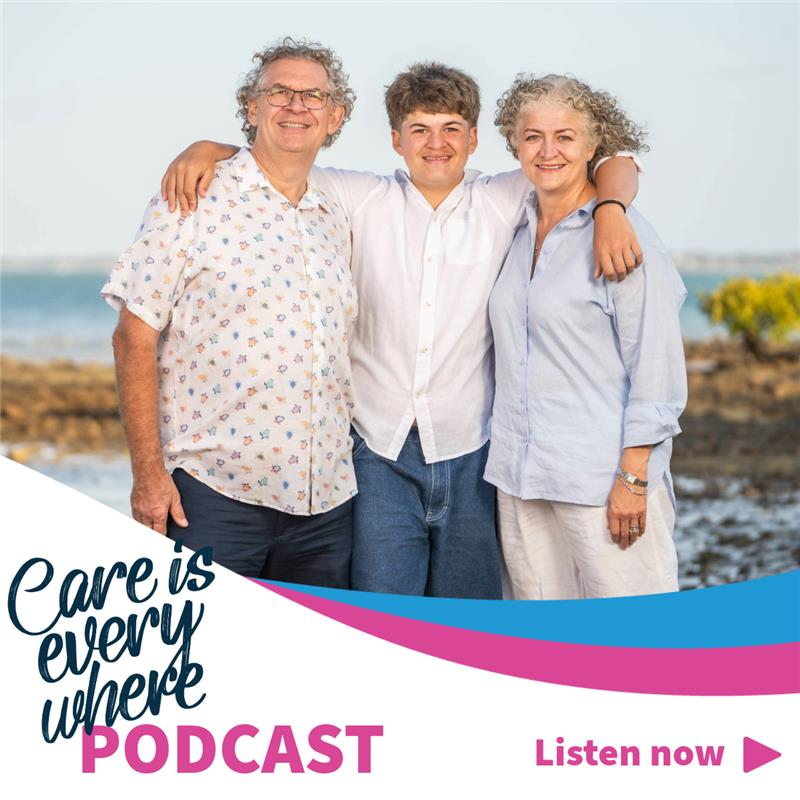
Meet 14 year old George from the seaside town of Hervey Bay. George is a young carer who plays a vital role in supporting his mother, who lives with Dupuytren's contracture, and his father, who's currently receiving treatment for prostate cancer.
Living with anxiety and dyslexia himself, George has become an advocate for young carers to ensure they have access to the resources they need to achieve, especially in schooling. In December last year, George represented Carers Queensland in Canberra as young carers from across Australia made their voices heard during a Parliamentary Friendship Group event.
In this episode, we also hear from George's mum, Liz, who reflects on the realities of young carers and shares how proud she is of her son. I began by asking George to share a little bit about his story.
[00:01:44] George:
I'm 14. I live with my mum, dad and two dogs. I like to fish, play the drums, ride my bike and do sport, including rugby union and football.
[00:02:15] Tracy:
And you have taken on a role of helping you support both your mum and dad at home, is that true?
[00:02:24] George:
Yes.
[00:02:26] Tracy:
What kinds of things do you help with and how did you learn to do so much at such a young age?
[00:02:33] George:
I help at home by cooking, cleaning, washing and ironing clothes. I do work in the garden and help move heavy bags and other items. I've always enjoyed helping since I was young and have been interested to learn new skills.
[00:02:50] Tracy:
What do you enjoy about helping George?
[00:02:54] George:
I just like helping other people. I like to make it easier for other people, which makes me happy.
[00:03:03] Tracy:
George, your mum lives with Dupuytron's contracture and your dad's going through prostate cancer treatment. What has that taught you about being patient, supportive or resilient?
[00:03:16] George:
It has taught me that being patient can be hard because when things don't Happen as quick as you would like, can lead to frustration and anger. But when we are patient, we can achieve anything. Being supportive and supportive helps everyone to achieve their goals. I've learned to be more resilient because when we have made mistakes, we have to learn to handle them and find ways not to make them again.
[00:03:47] Tracy:
So how do you stay patient?
[00:03:49] George:
By, like, listening, like listening to music, not trying to rush everything. And I do yoga and meditation, which also helps.
[00:04:02] Announcement:
As part of his caring role, George is also involved in supporting his father, who is undergoing prostate cancer treatment.
[00:04:12] George:
We have been to an event which was a motorbike ride out in support of prostate cancer. It was at the seafront Oval in Hervey Bay, and there were over 100 motorbikes. We met lots of older men with prostate cancer who invited us to a support group. But after thinking about it, we decided not to go because it was too hard for Dad to listen to a lot of other men's journeys.
[00:04:42] Tracy:
And you've also become a strong voice for people getting the support they need. Why is that so important to you, George?
[00:04:51] George:
It started when I was diagnosed with dyslexia and dysgraphia back in grade three. When my teachers didn't understand what support I needed to help me be the best I could be. I got involved with Code Red to raise awareness of dyslexia. I ended up writing to schools and politicians about why they shouldn't force all schools and teachers to take a day for dyslexia. After my dad was diagnosed this time last year, I was given support by young carers, Queensland and Canteen. This made me realise that being a young carer is a lot like having an invisible disability like dyslexia. I realized that most people don't know what you are going through and how to help you.
[00:05:37] Tracy:
Why do you want to raise awareness of this in society?
[00:05:44] George:
I want to make everyone have a fair chance in life.
[00:05:51] Tracy:
You also went down to Canberra recently, didn't you? Can you tell me about that trip?
[00:05:57] George:
The experience of going to Canberra and Parliament House and meeting young carers and politicians was an amazing experience. Hearing about other people's stories and how they handled things and sharing my story with people who have the power to change things at a national level was very important to me. I hope they have listened and will find ways to help everyone who needs help.
[00:06:23] Tracy:
If you could really influence change at a national level in federal politics, what would you like to see, George? What needs to happen?
[00:06:32] George:
I think the education system needs to be changed more. Being a Young carer is like having an invisible disability, like dyslexia, dysgraphia, or dyscalculia; no one's going to know until you tell them. So they should have it all set up so you don't have to feel embarrassed to tell someone and you speak there about school.
[00:07:00] Tracy:
What changes would you love to see so students like you and others can feel more supported at school?
[00:07:05] George:
The right learning, the right teaching, the right sport support and listening to music can always help calm people down. And the brain.
[00:07:20] Tracy: You do so much for other people, George, like at home, at school, in the community. What are you most proud of when you think about your caring journey so far?
[00:07:32] George:
That's a tough one because I don't want to do it for my own recognition. I want to help others and raise awareness about issues that I have experienced.
[00:07:43] Tracy:
Well, we've got Young Carers Action Day coming up and there's probably young carers out there, your age or perhaps even younger. If you could give a message to other young carers, what would you want them to know?
[00:07:56] George:
The main message I want other young carers to know is that they are not alone. There are more kids in their school and community that are experiencing the same challenges that they are.
[00:08:08] Tracy:
When you travelled to Canberra for the Young Carers barbecue, you met other young carers there. What was that experience like?
[00:08:16] George:
It was cool because I got to meet other young carers that were just like me, that had experiences a bit like mine.
[00:08:26] Tracy:
Did that make you feel more understood?
[00:08:29] George:
Yeah, it made me feel like I wasn't the only one and that I didn't have to explain myself.
[00:08:35] Tracy:
Do you find that you often do have to explain yourself because people in society don't understand?
[00:08:42] George:
Yeah.
[00:08:43] Tracy:
What about you? What's something that you're looking for? You're 14 now. What are your goals for the next few years?
[00:08:52] George:
One of them is probably get through school without failing myself and advocate more.
[00:09:00] Announcement:
George's mother, Liz, travelled with her son to the Parliamentary Friendship Group event in in Canberra and was impressed by the experience.
[00:09:09] Liz (mother):
From my point of view, it was a privilege to watch George's confidence grow through the barbecue, through the time we were in Canberra, from the morning to the end of the barbecue to see his confidence increase with the support of everyone from Carers Queensland and Carers Australia, and also from the carers in the other states, but also seeing him interact with the other young people who were all older than him, but having seen how they interacted with George was, was lovely, but also then seeing his confidence grow as the day Went on with his ability to communicate with the MPs and senators and with everybody else. It was. It was a real privilege to see that.
[00:10:01] Tracy:
You must have been so proud.
[00:10:03] Liz:
Oh, yeah, of course, of course. Yes, definitely.
[00:10:08] Tracy:
Liz, did you have any idea that your son was going to become an advocate for carers?
[00:10:16] Liz:
We got an email shortly before a phone call and then to receive an email to say, yeah, George has been selected. It was quite mind blowing in some respects. It was really. For us, it was really lovely that, to see that other people could recognize in him his ability to advocate for himself. But for others as well, it was, yeah, it was really special.
[00:10:46] Tracy:
What was the atmosphere of the meeting down in Canberra. How would you describe it to an outsider?
[00:10:53] Liz:
What do you think it was like? George? It was really special, wasn't it? It was a real. I think both of us was. Initially we were quite in awe of what was going on, but I think being in Canberra itself and then actually being in the House of Parliament or Parliament House and then meeting people, it was fantastic. It was a really amazing experience for both of us. We both really enjoyed it.
[00:11:22] Tracy:
Liz, how would you like to see government change? What would you like to see more of for carers?
[00:11:30] Liz:
Yeah, I think seeing the support for the young carers would be really important, is really important because there are a lot of them that aren't recognised by the community at large, by schools. I think when my husband and I were growing up, it was just what you did. You just got on with it and helped. And I think George was a bit like that as well. I don't think we realized how much extra he was doing to help and support us. And I think that they almost need some sort of like support groups for these young people because there are a lot of them that do an awful lot for people and for family members and for other people as well.
[00:12:17] Tracy:
And that would impact schooling and their own lives and. Yes, and you would say that.
[00:12:25] Liz:
Yeah, yeah, very much so.
George. George will want to go and hang out with me, but he knows that he's. He's got quite a lot of responsibilities before he can get to that point. To be able to go out and hang out with his mates and to go fishing and play the drums, but he finding that work, that balance for him is. Yeah, it's really important.
[00:12:50] Tracy:
What you were saying before is so true. When people think of carers, they don't often think of young carers, do they?
[00:12:56] Liz:
No, they don't. And I still think that George's phrase, which he talked to them when we were down in Canberra, which was being a young carer is like having a hidden disability because unless you tell people they don't know. And I think that young people are very loath to, to broadcast to their peers what they're doing at home for fear of being mocked, for fear of being teased or, you know, because it's not a cool thing to do.
[00:13:29] Tracy:
Well, hopefully we can change that with Young Carers Action Day to shine a light on that.
[00:13:34] Liz:
Yeah, yeah, I think that's really important.
[00:13:39] Announcement:
And that was Liz, mother of George, who's a young carer and advocate. To find out more about Young Carers Action Day, follow the link to our website in the episode transcript.
Thank you for listening to Carers Everywhere, a podcast by Carers Queensland. If you've enjoyed this episode, please rate, review and share. For more information on Carers Queensland, visit our website carersqld.com.au or call our enquiry line on 1300 999 636 or follow us on Facebook.